Post-Tensioned Concrete Foundations: Benefits for Oahu Home Construction
What You Need to Know: Post-tensioned concrete foundations give Oahu homeowners a stronger, thinner, and more crack-resistant slab than conventional reinforced concrete. In Hawaii’s variable soil conditions, coastal humidity, and high-cost repair environment, those advantages often make post-tensioning the smarter long-term investment.
Most homeowners do not think much about their foundation until a problem appears. That is understandable because a foundation is not exactly the most exciting part of building a home. But on Oahu, where soil conditions can shift dramatically from one neighborhood to the next, and where volcanic rock, expansive clay, coastal moisture, and older fill lots create real slab challenges, the foundation decision deserves far more attention than it usually gets.
Post-tensioned concrete is one of the approaches that experienced Hawaii contractors increasingly recommend for residential foundations. Here is what it actually means, why it performs especially well in Oahu conditions, and what homeowners should know before deciding whether it is the right choice for their project.
What Post-Tensioning Actually Is
Standard reinforced concrete relies on steel rebar embedded in the slab to provide tensile strength, helping the concrete resist cracking when it bends or flexes under load. Post-tensioning takes a more active approach.
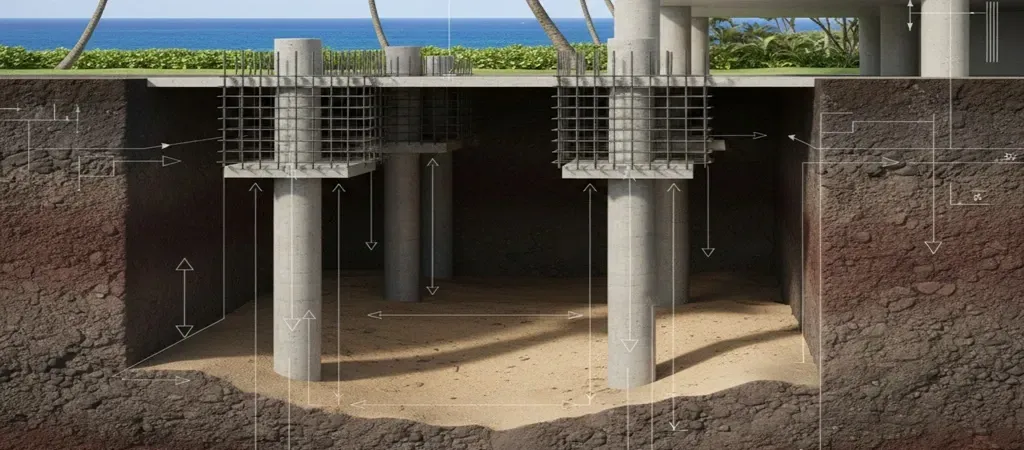
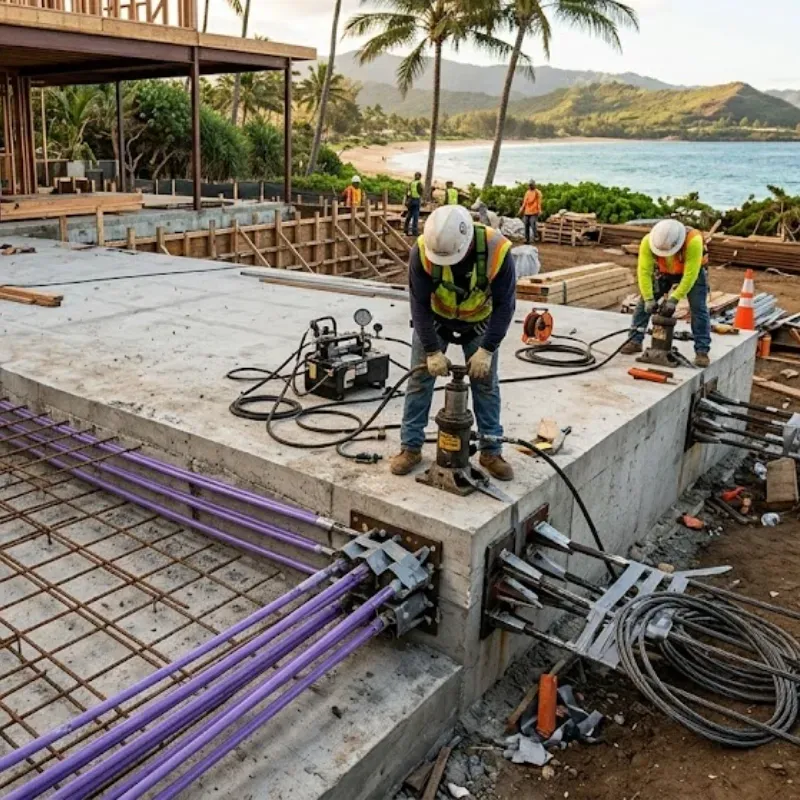
Instead of relying on passive rebar alone, high-strength steel tendons are run through the slab inside protective plastic sheaths. After the concrete reaches the required curing strength, those tendons are tightened using hydraulic jacks and then anchored at the slab edges. This places the slab under compression, which is the condition concrete handles best.
The result is a foundation that actively resists cracking instead of only reinforcing the concrete after the fact.
When structural loads, soil movement, temperature swings, or moisture changes place stress on the slab, the pre-compressed concrete distributes those forces far more effectively.
For homeowners researching residential concrete foundations on Oahu, this method often provides a stronger long-term slab solution than a conventional reinforced design of similar thickness.
Why It Matters Specifically on Oahu
Oahu’s soil conditions are far more varied than what you see in many mainland builds. Depending on the lot, contractors may encounter shallow basalt rock, expansive clay soils, loose fill from previous grading, sandy coastal soils, or multiple transitions within the same property.
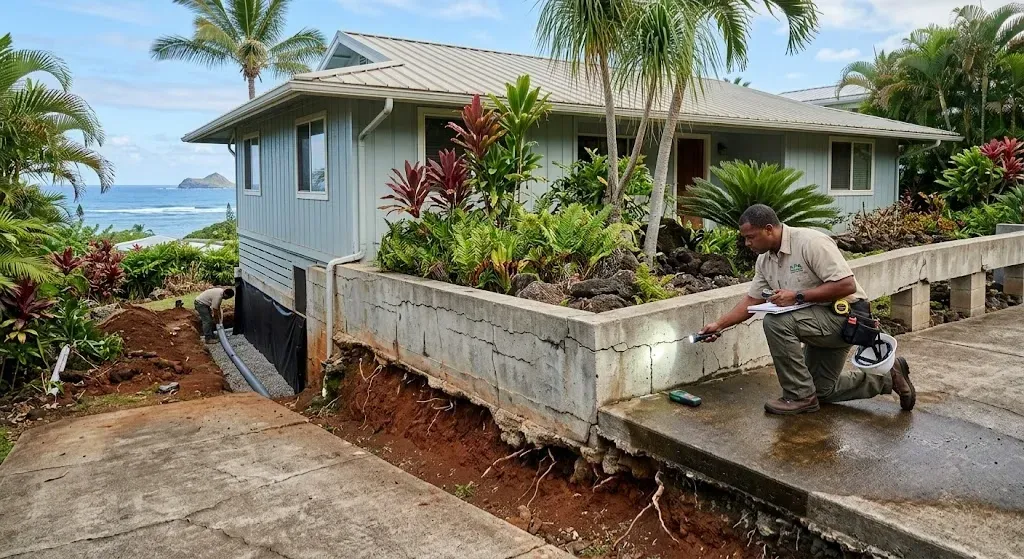
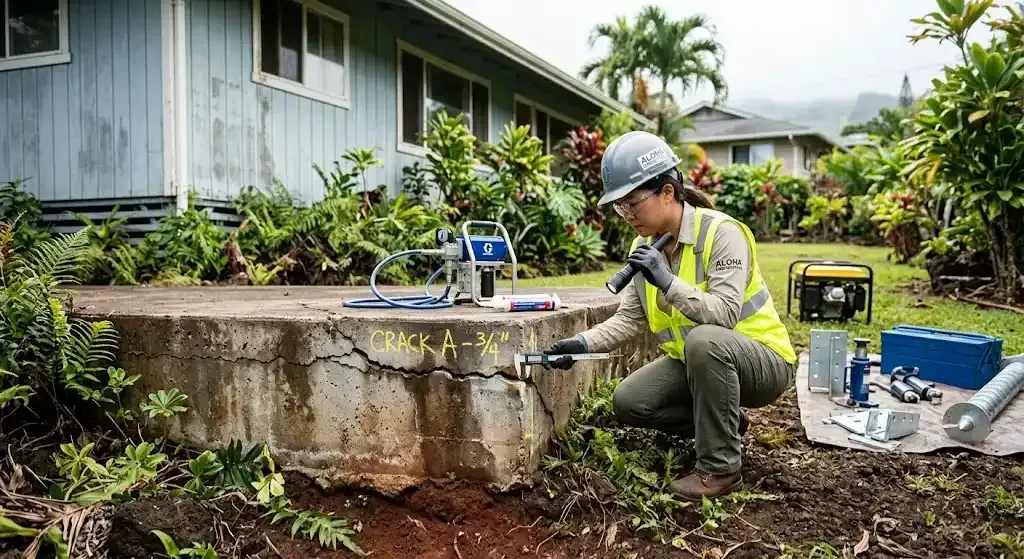
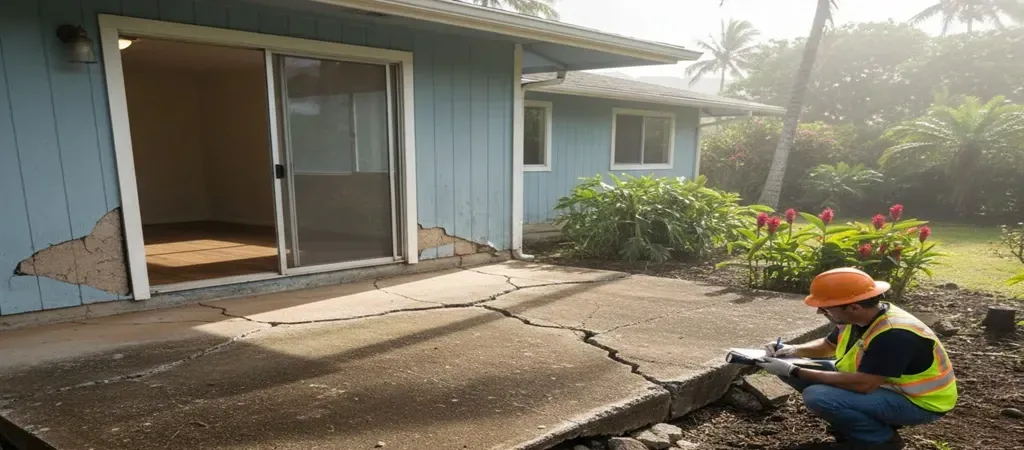
That variability creates one of the biggest slab risks: differential settlement, where one section of the slab shifts or settles differently than another.
Conventional slabs are more vulnerable to cracking under those conditions. Post-tensioned slabs perform better because the slab compression helps keep the structure intact even when the soil beneath it behaves unevenly.
This becomes even more valuable in Oahu’s coastal and humid environments. Salt air and constant moisture can accelerate corrosion in traditional rebar systems if the concrete cover is ever compromised. Because post-tensioned tendons are sealed within protective sheaths and end caps, they tend to hold up better over time in coastal exposure.
Practical Advantages for Oahu Homeowners
Better Crack Resistance
The most immediate benefit is crack prevention. A properly installed post-tensioned slab remains significantly more resistant to cracking throughout its service life, even on lots where soil movement is unavoidable.
Thinner but Stronger Slabs
Post-tensioned slabs can often be poured thinner than conventional reinforced slabs while still delivering equal or better structural performance. In Oahu, where concrete, freight, labor, and site-access costs are high, that efficiency can create meaningful savings.
Lower Long-Term Maintenance
Fewer cracks mean fewer moisture entry points, fewer slab repairs, and lower long-term maintenance costs. In Hawaii’s climate, where water intrusion can quickly turn into a larger structural issue, long-term durability matters.
What the Installation Process Looks Like
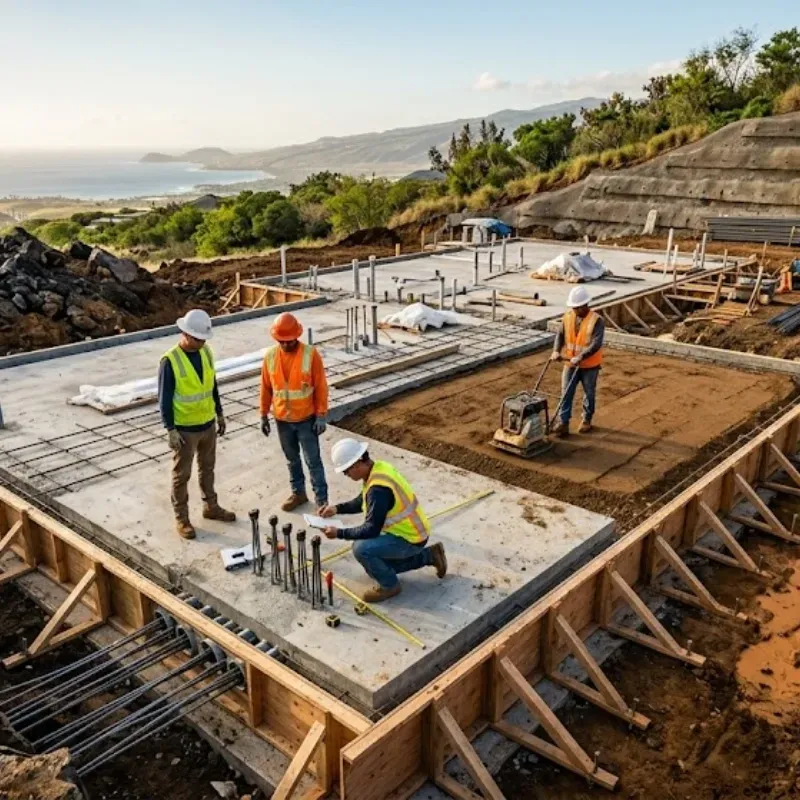
Building a post-tensioned foundation follows the same broad sequence as conventional slab construction: site preparation, forming, pouring, curing, and finishing. The difference is that the technical precision required is much higher.
The tendon layout must be engineered around the actual load conditions and soil behavior of the site. The concrete must also reach the required strength before the stressing phase begins.
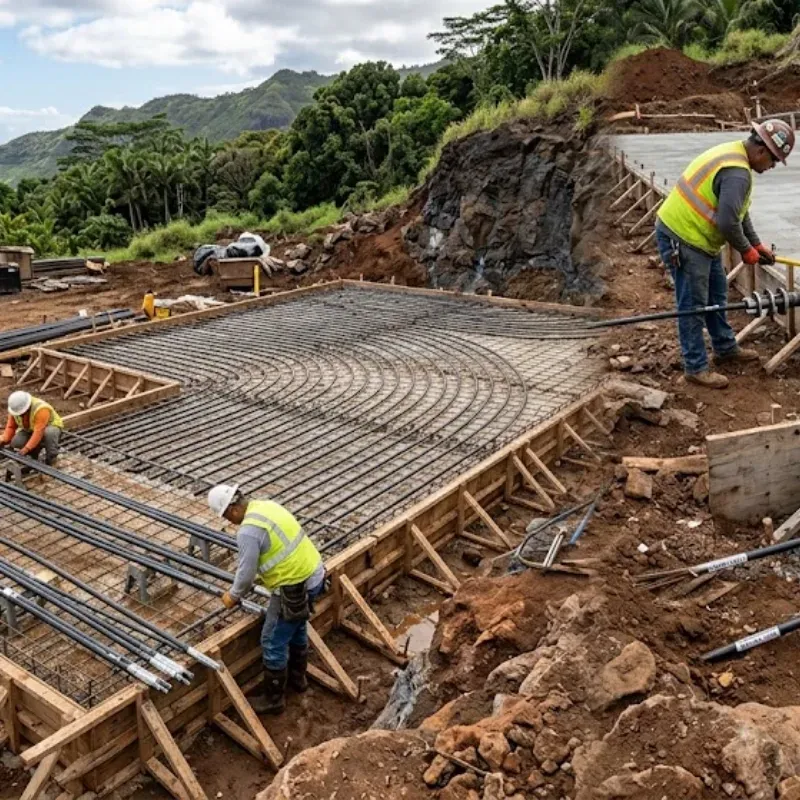
Once cured, hydraulic jacks are used to tension the tendons to the engineered force. Those tendons are then anchored securely at the slab edges, locking the concrete into compression.
Because Oahu lots often include volcanic rock shelves, clay pockets, moisture-sensitive fill, and slope changes, contractor accuracy during this phase is critical. Even small stressing or layout errors can reduce long-term performance.
Why Contractor Experience Matters More in Oahu
Post-tensioning performs best when the slab design, site preparation, and stressing process are aligned with real island conditions.
What works on a flatter lot in Kapolei may not be the right solution for a hillside build in Kāneʻohe, a tighter urban lot in Honolulu, or a coastal site exposed to salt-heavy trade winds.
At Oahu Concrete Professionals, every slab system should be planned around actual soil conditions, drainage behavior, structural loads, and long-term movement risk rather than a generic slab template.
This is also where site preparation, drainage behavior, and long-term movement risk matter most during planning.
Is a Post-Tensioned Foundation Worth It for Oahu Homes?
For many homeowners, yes.
The combination of better crack resistance, stronger soil movement performance, thinner slab efficiency, and reduced long-term maintenance often makes post-tensioning the smarter choice in Oahu’s environment.
While the engineering and stressing process requires more upfront expertise, the long-term reduction in cracking, repair cycles, and slab performance issues usually creates better overall value. This is especially true when compared to foundation inspection needs in Oahu homes that often result from slab movement and cracking issues.
In an island construction market where labor and repairs are expensive, getting the foundation right the first time is usually the smarter investment.
Ready to Build on the Right Foundation?
A foundation should do more than support the home above it. It should be built for the realities of the soil below it.
For Oahu homes dealing with volcanic rock, clay movement, fill soil, hillside loads, and coastal moisture, post-tensioned slabs often provide a stronger long-term solution with fewer structural headaches.
If you are planning a new build, Oahu Concrete Professionals can help evaluate your site conditions and recommend the right foundation system for long-term performance.