Foundation Cracks in Hawaii: Causes, Risks, and Repair Solutions
What You Need to Know: Not all foundation cracks are emergencies, but none should be ignored in Hawaii. Volcanic soil, high humidity, heavy rainfall, and seismic activity can turn minor cracks into bigger problems faster than most homeowners expect. Knowing what you’re looking at is the first step toward the right repair decision.
If you have noticed a crack in your foundation, your first instinct might be to assume the worst — or to convince yourself it is nothing and move on. The reality is usually somewhere in between, but in Hawaii the stakes are often higher than they are in most places. The combination of volcanic soil, salt air, persistent moisture, and occasional seismic activity means that foundations here face stresses that are genuinely different from what you would encounter on the mainland. A crack that would be a minor cosmetic issue elsewhere can signal something more significant when it shows up on Oahu.
This guide explains what causes foundation cracks in Hawaii, what different crack types may indicate, and which repair options are actually available. The goal is to give you enough context to have a real conversation with a contractor — not to create unnecessary alarm, but also not to let something important slide.
Why Hawaii Foundations Crack More Than People Expect
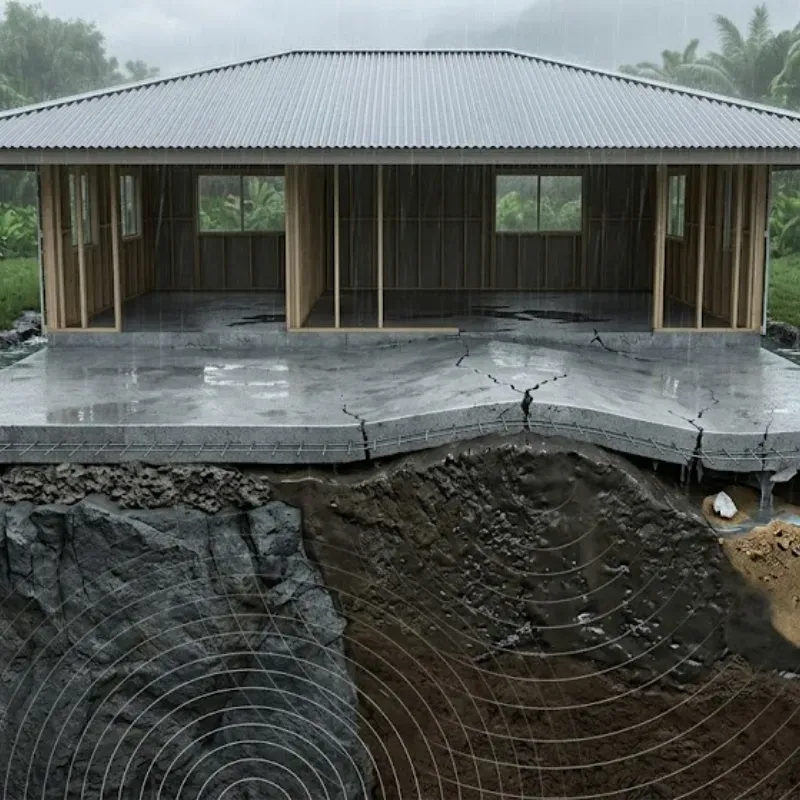
Hawaii is not an easy place to build in. The soil across Oahu varies dramatically from one neighborhood to the next. In some areas, you hit dense basalt close to the surface. In others you have expansive clay that swells when wet and contracts when it dries. In coastal areas and older neighborhoods, loose fill and decomposed material from decades of development can create uneven bearing conditions beneath a slab. Any of these can cause a foundation to move, and movement is what creates cracks. Professional foundation crack repair in Oahu starts with identifying what caused the movement — because patching a crack without addressing the underlying cause is just a temporary fix that gives you false confidence.
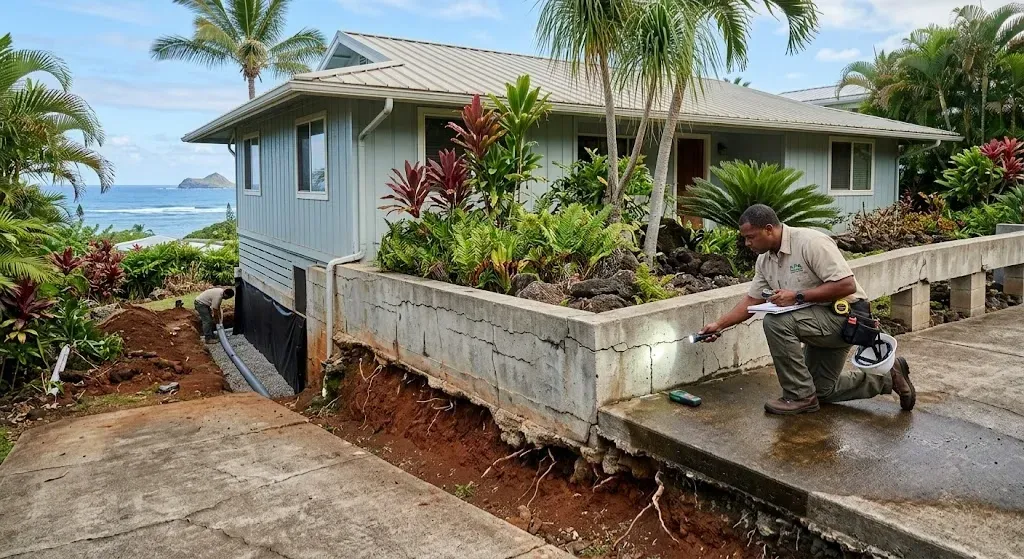
Rainfall is another significant factor. Oahu receives heavy rain, and when water does not drain away from a foundation properly, it saturates the soil, changes its bearing capacity, and creates conditions for erosion under the slab. Over time, voids develop beneath the concrete, and without support the slab flexes and cracks. This is one of the most common foundation problems on the island and one of the most preventable with proper drainage design from the start.
Hawaii’s seismic activity also plays a role. The islands sit in an active geological zone, and while major seismic events are not frequent, the minor tremors that occur regularly can gradually stress a foundation over years. A foundation that was marginal to begin with — poorly prepared subbase, inadequate reinforcement, insufficient concrete thickness — will show the effects of that cumulative stress sooner than one that was built to a higher standard.
How to Read What a Crack Is Telling You
Not all cracks mean the same thing, and the type, size, direction, and location of a crack give a trained eye a lot of useful information. For homeowners, knowing the broad categories helps you have a more informed conversation when you bring in a professional.
Hairline cracks that run in relatively straight lines are usually the result of shrinkage during the original curing process. Concrete loses moisture as it cures, and fine cracks from that process are common and generally not a structural concern. They can, however, become pathways for moisture infiltration if left unsealed, which is why they are worth addressing even when they are not structurally significant.
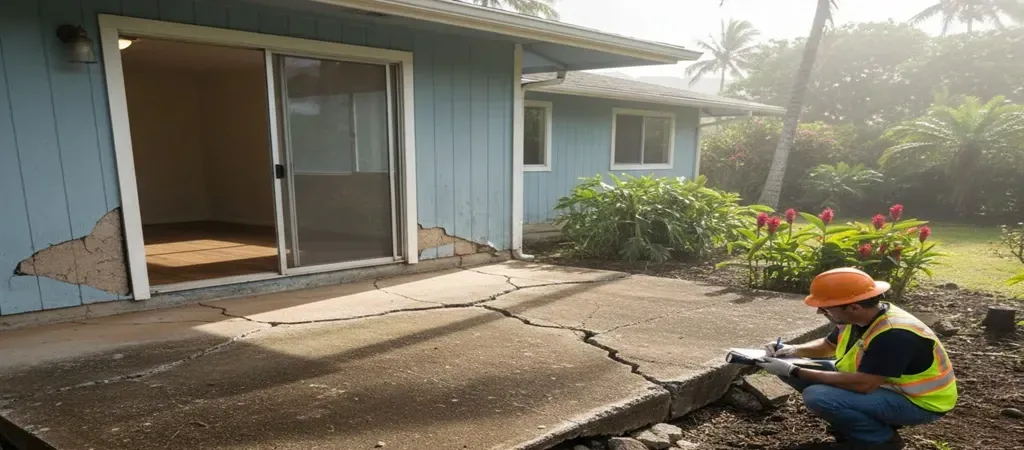
Diagonal cracks — especially those that run at roughly 45-degree angles from corners of openings like doors and windows — are often a sign of differential settlement. One part of the foundation has moved more than another, creating shear stress in the concrete. In Hawaii’s variable soil conditions, this is a relatively common finding and the severity depends on how much movement has occurred and whether it is still active.
Horizontal cracks in basement walls or stem walls are generally the most serious. They indicate lateral pressure from soil pushing against the wall, which can compromise the wall’s structural capacity. In Hawaii, where heavy rainfall can saturate soil quickly and dramatically increase lateral pressure, horizontal cracks in vertical foundation elements should be evaluated promptly by someone qualified to assess structural integrity.
Cracks with displacement — where one side of the crack is higher or lower than the other — indicate that movement has already occurred. The more displacement there is, the more significant the underlying cause is likely to be.
The Risks of Leaving Foundation Cracks Unaddressed
The most immediate risk is water infiltration. Cracks in a foundation provide a direct path for moisture to enter the structure, and in Hawaii’s humid climate that moisture can cause a cascade of secondary problems — mold, wood rot in framing above the foundation, corrosion of embedded steel reinforcement, and deterioration of flooring and interior finishes. What starts as a small crack can, over time, enable damage that costs far more to remediate than the original crack repair would have.
Structural risk is the more serious concern with larger or actively growing cracks. A foundation that is moving or settling unevenly affects everything above it. Doors and windows that stick, floors that feel uneven, cracks in interior walls — these are the downstream symptoms of a foundation that is not doing its job. At Oahu Concrete Professionals, we have seen cases where homeowners lived with those symptoms for years before realizing the source was a foundation issue that had been quietly getting worse. The earlier a structural concern is identified and addressed, the more options are available and the less expensive the solution tends to be.
In Hawaii specifically, there is also the issue of salt air corrosion. Coastal properties face accelerated corrosion of steel reinforcement when moisture infiltrates through cracks. Once the rebar begins to rust, it expands and can cause the surrounding concrete to spall — a process that, once started, is difficult and expensive to stop. Sealing cracks before they allow moisture infiltration is one of the most effective preventive measures available.
Repair Options: What Actually Works
The right repair depends on the cause, the type of crack, and whether the movement that caused it is still active. For hairline and non-structural cracks, epoxy injection or polyurethane foam injection can seal the crack effectively and restore the concrete’s watertight integrity. These are minimally invasive repairs that can typically be completed in a day.
For cracks caused by differential settlement, the repair has to address the settlement itself, not just the crack.
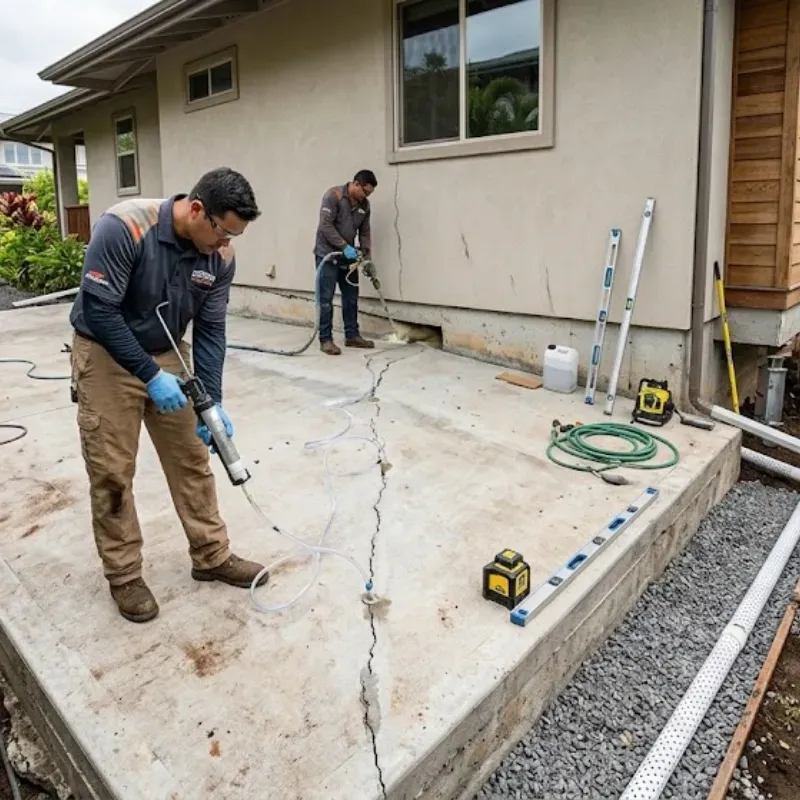
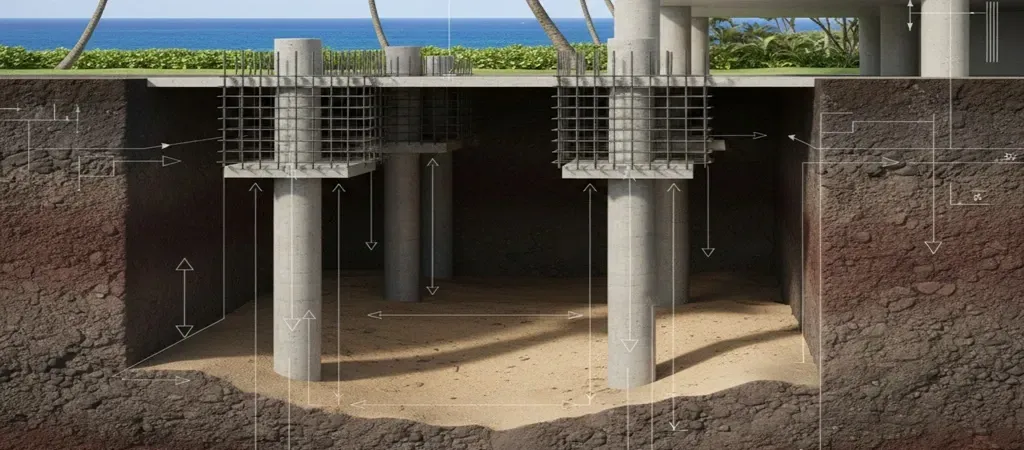
Depending on the cause and the extent of the movement, this might involve underpinning — extending the foundation’s support to deeper, more stable soil — mudjacking or foam injection to fill voids beneath the slab, or in more significant cases, partial or full slab replacement with corrected subbase preparation.
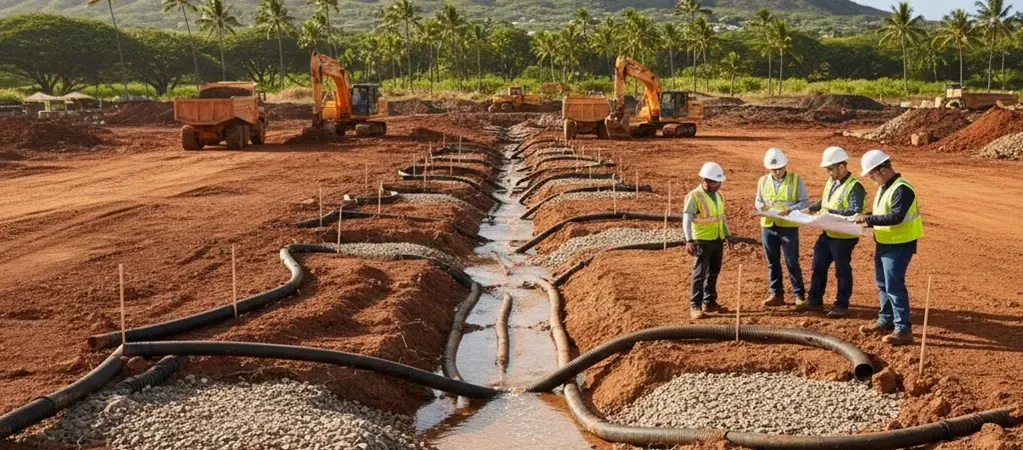
Drainage correction is often part of the repair solution even when it is not the most visible intervention. If water management around the foundation was contributing to the problem, fixing the crack without fixing the drainage means the same forces will continue to act on the repaired concrete. Grading corrections, French drains, and downspout extensions are frequently part of a complete foundation repair strategy in Hawaii.
When to Bring in a Professional
As a general rule, any crack that is wider than a hairline, shows displacement, is growing, or is accompanied by symptoms in the rest of the house — sticking doors, uneven floors, interior wall cracks — warrants a professional evaluation. Not every crack is a crisis, but without experience, it is not always easy to tell the difference between a cosmetic issue and a structural concern.
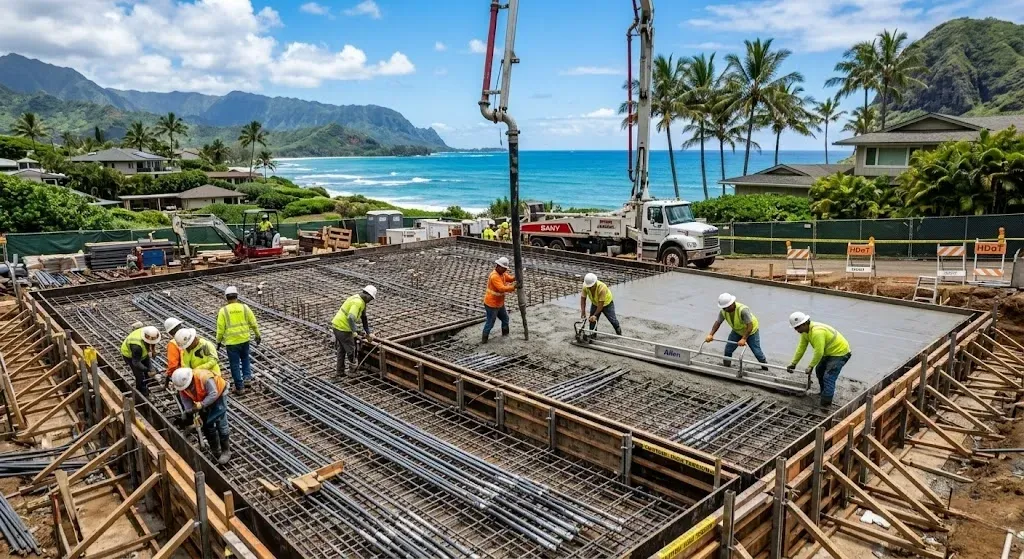
A good contractor will not just look at the crack. They will look at the pattern of cracking, the soil conditions, the drainage around the foundation, and the overall condition of the structure to give you an honest assessment of what is actually happening and what the appropriate response is. If you are building new or doing significant work on an existing property, understanding how proper concrete foundations on Oahu are designed and built helps you know what to look for and what questions to ask before problems develop.
Prevention: The Better Investment
Most foundation problems in Hawaii are the result of conditions that were either present at the time of construction or developed gradually over years of deferred maintenance. The most common contributors are inadequate subbase preparation, poor drainage design, insufficient concrete thickness or reinforcement, and a lack of ongoing maintenance to keep cracks sealed before they allow moisture infiltration.
For homeowners in existing structures, the practical prevention steps are straightforward: keep the soil around the foundation graded to drain water away from the house, make sure gutters and downspouts are directing water well clear of the foundation, and seal any cracks as soon as they appear — before they become pathways for the moisture that accelerates deterioration.
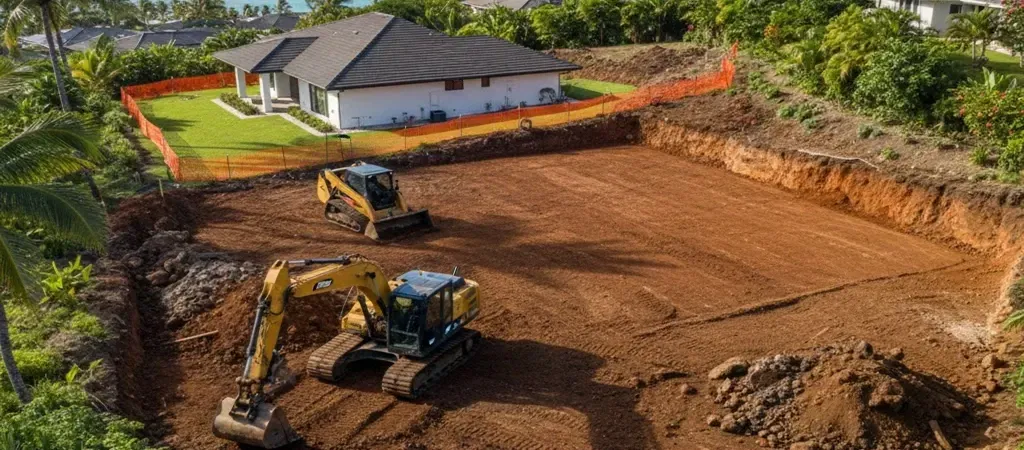
Proper drainage is often the most overlooked part of foundation maintenance. In Hawaii’s rainfall environment, water management around a structure is not optional — it is fundamental. If you are concerned about drainage on your property or are planning excavation work that might affect how water moves across your site, our excavation and drainage work in Oahu services cover the full range of site preparation and grading solutions that protect foundations from the water-related problems that are so common in Hawaii’s climate.